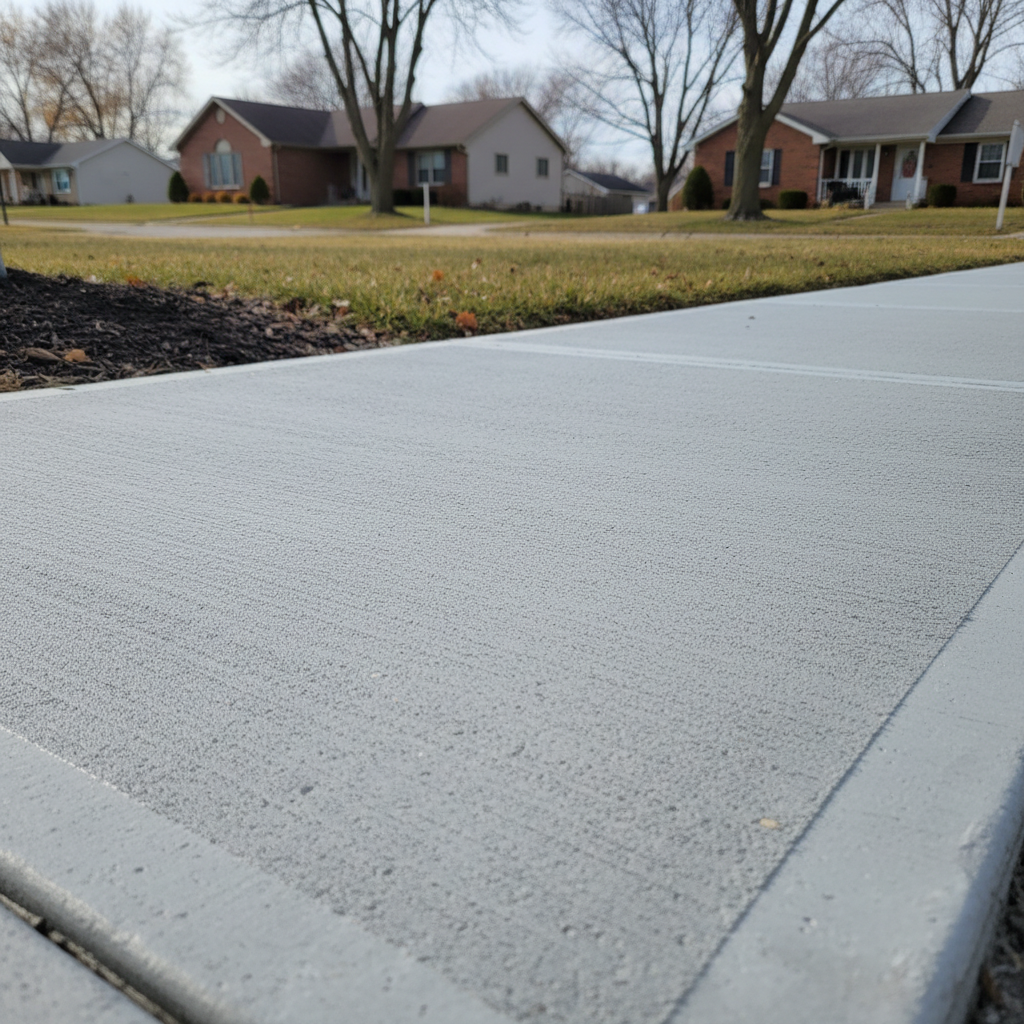
Many homeowners look down at their front walkway and wonder why it is suddenly shifting or cracking apart. If you live around the West Side or closer to downtown Aurora, you already know our weather puts concrete through a very difficult cycle. Between heavy clay soils that expand and contract and our freezing winter freeze-thaw loops, concrete sidewalks take a beating. Over the years running Mighty Concrete, I have heard just about every question a homeowner can ask about sidewalks. Let us walk through the most common ones.
Do I need a permit to replace my sidewalk in Aurora?
Yes, usually. If you are replacing a public sidewalk square that sits in the city right-of-way between your front lawn and the street, the City of Aurora generally requires a permit. They want to make sure it meets grade and ADA requirements. If it is a private walkway entirely on your property leading up to your front porch, you often do not need a city permit, but it is always smart to check local ordinances before breaking ground. Skipping permits on public property can lead to fines or a forced tear-out if an inspector drives by. Mighty Concrete helps homeowners navigate these local requirements every day.
Why is my sidewalk sinking on one side?
That usually comes down to our local soil conditions. Aurora has a lot of heavy clay underneath us, which holds onto moisture. When it rains heavily, the clay swells up. When it dries out in July and August, it shrinks. That constant movement creates voids under the slab. Add in a poorly compacted sub-base when the walk was originally poured twenty years ago, and one side is bound to drop. Downward pressure from foot traffic finishes the job.
Can tree roots be cut without killing my tree?
It depends on how thick the root is and how close it sits to the trunk. If a massive silver maple or oak has roots lifting your sidewalk slabs three inches into the air, you are in a tough spot. You can cleanly cut smaller lateral roots to lay down a proper gravel base for a new pour, but cutting structural roots right next to the trunk will compromise the tree health and stability. Sometimes the real fix is routing the new sidewalk slightly around the root zone rather than fighting nature.
How long do I have to stay off a new sidewalk?
Mighty Concrete tells homeowners to keep foot traffic off for at least 48 hours. If you have dogs or kids, that is the hardest part. Concrete achieves about 70 percent of its compressive strength in the first week, and it keeps hardening for months. Walking on it gently after two days is fine, but keep heavy rolling loads, like a loaded wheelbarrow or delivery trucks, off the slab for a full week.
Will de-icing salts ruin my new concrete walk?
They will chew it up if it is brand new. Concrete needs time to fully cure and dry out before it faces harsh chemical salts. If you throw rock salt on a fresh winter pour during its first season, the surface will scale and pit terribly. Use plain sand for traction during that first winter instead. Once the sidewalk is a year old, you can use commercial ice melters sparingly, though calcium magnesium acetate is always kinder to the material than standard sodium chloride.
Should I repair a crack or replace the whole slab?
It depends entirely on the depth and width of the damage. Hairline surface cracks can usually be sealed up with a quality polyurethane caulk to keep water from getting underneath and freezing. But if a slab is shattered into four pieces, sunken on one end, or flaking badly across the entire surface, patching it is just throwing money at a temporary fix. Breaking it out and pouring a fresh, reinforced section is the only way to get another 30 years out of it.